Ask a regulatory writing team where the current version of a document lives and you'll usually get a filename. Something like CSR_v14_FINAL_reviewed_v2.docx, sitting in a folder, or attached to an email from Tuesday. That file is treated as the thing — the artifact you edit, the object you pass around, the source of truth.
I think that's backwards, and I think it's the quiet cause of half the pain in this work.
The document isn't the truth. It's a render of the truth. Underneath every sentence in a clinical study report there's a decision about what the data showed, a source it came from, a reviewer who signed off, an edit history of how it got to its current wording. The Word file flattens all of that into text on a page. It keeps the output and throws away everything that produced it. Then we treat the flattened thing as authoritative and wonder why provenance is so hard to reconstruct later.
Watch what goes wrong when the file is the source of truth. Two people edit their own copies and now there are two truths, reconciled by hand. A claim gets questioned in review and no one can say where it came from, because the file doesn't carry its own history. A number changes upstream and the three places it was pasted downstream don't. None of these are writing problems. They're all the same structural problem wearing different clothes: the artifact holds the content but not the reasoning, so the reasoning has to be rebuilt from memory every time someone asks.
The alternative is to move the source of truth off the document and into a backend that actually captures the whole thing — every draft, every change, who made it and why, every source a claim is grounded in, everything the tooling did on the writer's behalf. Not a folder of files. A real record of the work. And then the document becomes what it always should have been: a view of that record. One render among several.
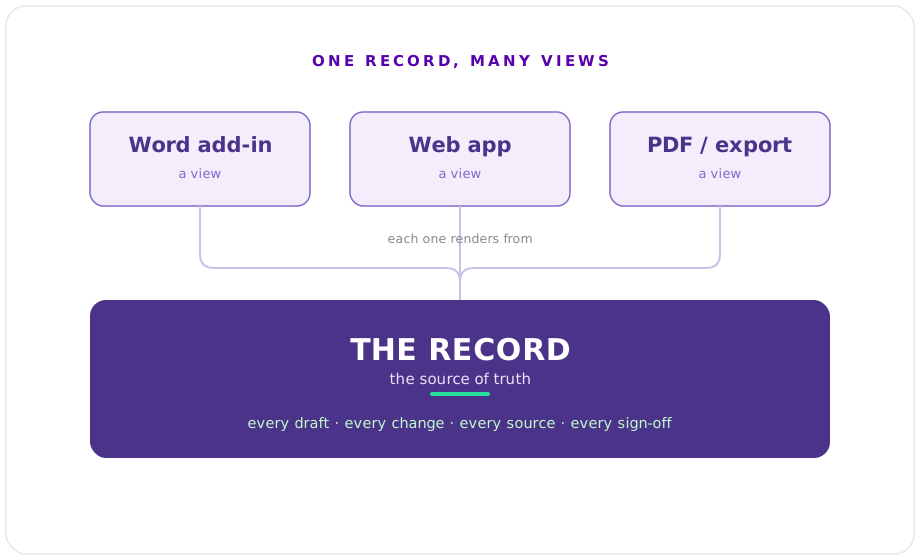 Word and the web app aren't two documents. They're two views of the same record — which is the thing that's actually true.
Once the truth lives in the backend, a few things stop being hard.
Provenance stops being an archaeology project. If every claim is tied to its source and its edit history in the record, then tracing one is a lookup, not an investigation. The document doesn't have to carry its own history because the backend already does.
The interface stops being the vendor's decision. If the document is a render, then Word is one render and a web app is another, over the same underlying truth. A writer who lives in Word keeps living in Word. A writer who wants something richer opens the web surface. They're editing the same document because there is only one document — the record — and these are just two windows onto it. Nobody is forced to move.
And collaboration stops being a feature you bolt on. The reason co-authoring is a mess today is that everyone has their own file. When there's one shared record instead of copies, more than one person working the same document is just the normal case, not a special integration that breaks on the edge. You don't build collaboration. You stop preventing it.
The mental shift under all of this is that the writer's core act changes. It stops being typing the document and becomes curating the record — deciding what's in, what's grounded, what's approved. The prose is downstream of that. When people first hear it they think it sounds abstract, but it's the opposite: it's what makes the concrete problems above go away.
I'm building a tool on exactly this premise, so weigh that. But the idea doesn't need the tool. The next time a version-control mess eats an afternoon, or a reviewer asks where a claim came from and the room goes quiet, notice that the document couldn't answer — because the document was never the thing that knew. Something behind it was, and most tools throw that away.